The bottle price is not the interesting part
Every wine professional knows how to calculate the cost of a glass.
A 750ml bottle poured at 125ml gives you six glasses. Multiply, divide, add your target, move on.
The arithmetic is useful. It is not the insight.
The more interesting question is what happens after that wine earns a position on the list.
Does the team recommend it?
Does it open conversations or require explanations nobody has time to give?
Does it give guests a reason to trade up?
Does it finish before it deteriorates?
Does it add something to the wine programme that the glass next to it does not already provide?
And, ultimately, does the restaurant want to reorder it?
That is where by-the-glass economics become more interesting than bottle price.
Because a BTG position is not simply six portions of wine. It is a small piece of commercial real estate.
And that real estate needs to work.
The scarce resource is not wine. It is the position on the list.
Most restaurants cannot keep adding wines by the glass indefinitely.
Every position competes for menu space, stock, working capital, refrigeration, staff training and, most importantly, guest attention.
So the real comparison is rarely between a €10 bottle and a €20 bottle.
It is between what those two wines can do with the same position on the list.
One might be slightly cheaper but duplicate something already there.
Another might create a new price point, work across more dishes, give the sommelier a useful recommendation when somebody asks for something different, or provide an accessible route into a category the restaurant wants to develop.
That second bottle may be more valuable before the first glass is even poured.
This is why looking at BTG only through purchase price can produce perfectly rational decisions that create very boring wine lists.
The list becomes full of wines selected to minimise input cost rather than maximise the value of the position they occupy.
There is a difference.
A glass is not just a smaller bottle. It is a lower-risk way to discover wine.
This becomes especially important when working with less familiar regions and varieties.
Asking somebody to spend €45 or €60 on a bottle of a grape they cannot pronounce is one kind of proposition.
Asking them to try a glass is another.
By-the-glass removes part of the commitment.
That makes it one of the most useful places on a wine list to introduce something that is new to the guest but not necessarily difficult in the glass.
And that distinction matters.
Unfamiliar does not have to mean challenging.
A Greek Assyrtiko, a Limniona or a Sicilian Nero d’Avola may carry less immediate recognition than Chardonnay, Pinot Noir or Sauvignon Blanc. But the actual drinking experience can be remarkably easy to position if the wine has a clear stylistic reference point.
The opportunity, then, is not simply to find wines that cost little enough to pour.
It is to find wines where the distance between unfamiliarity and understanding is short.
That is commercially useful territory.
The guest discovers something.
The restaurant differentiates its list.
And the unfamiliarity that initially looked like a disadvantage starts doing some work.
Complexity is expensive
There is, however, a catch.
Every unfamiliar wine carries an explanation burden.
If the only person capable of selling it is the head sommelier, you do not really have a BTG wine. You have a specialist recommendation that happens to be available by the glass.
Restaurants operate through teams.
A wine has to survive Friday night at 21:15 when the floor is full, three tables want to order and nobody is delivering a five-minute lecture about soil composition.
This is where sales material and staff training stop being marketing accessories and become part of the commercial model.
The objective is not to remove the story.
It is to compress it.
Suppose a guest says:
“I normally drink Chablis.”
The answer does not need to begin with a history of Assyrtiko.
It can begin here:
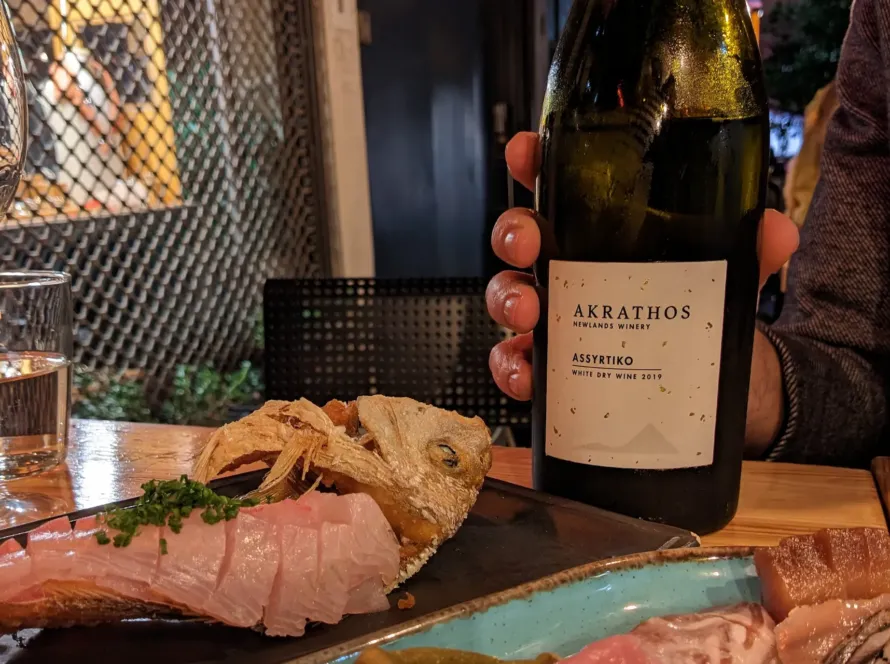
“Try the Akrathos Assyrtiko. It has the acidity and wet-stone tension you probably like in Chablis, but with a little more Mediterranean fruit and texture from its lees ageing.”
Now we have somewhere to go.
The wine itself can take over from there.
If the guest is interested, the conversation can continue into Northern Greece, altitude, Assyrtiko and the producer.
If not, it does not need to.
That is the important part.
Good commercial translation creates different depths of explanation for different guests. The enthusiast can have the details. The curious newcomer gets a reference point. The person who simply wants a good glass of white wine gets a confident recommendation.
One wine. Three different conversations.
A technical sheet cannot do that on its own.
The sweet spot is unfamiliar wine, familiar pleasure
There is a temptation in wine to treat discovery as an end in itself.
Rare grape. Tiny region. Strange label. Job done.
Not quite.
Difference has commercial value only when somebody wants the second glass.
The interesting part of underrepresented wines is not that they are obscure. Obscurity is easy.
The interesting part is finding wines that provide differentiation without asking the guest to work particularly hard for the pleasure.
That is a much narrower target.
A distinctive wine can give a restaurant something that another internationally distributed Chardonnay cannot.
There may be less direct price comparison. The restaurant gets a stronger point of view. The service team has a reason to make a recommendation rather than simply take an order. And the wine can become associated with that particular venue rather than feeling interchangeable with the list next door.
But push too far into novelty and the advantage disappears.
If every sale needs persuasion, the wine becomes operationally heavy.
If nobody can place the flavour profile, the glass becomes risky.
If the story is more interesting than the liquid, curiosity produces one order and not another.
The commercial sweet spot sits somewhere between predictable and difficult.
Recognisable enough to sell.
Different enough to matter.
You don’t put margin in the bank. You put earnings.
This is where the financial conversation deserves to return.
Not because margin is irrelevant. Of course it matters.
But percentage margin is a measure, not the objective.
A restaurant does not deposit percentages.
It deposits money.
A wine can carry a beautiful mark-up and contribute very little because it moves slowly. Another can have a less impressive percentage, command a stronger glass price, move consistently and generate considerably more earnings from the same position on the list.
The more useful unit of analysis is therefore not necessarily margin per bottle.
It is what this position contributes over time.
Over a week.
Over a month.
Across lunch and dinner services.
Across different members of the team.
That changes the questions.
How often is it recommended?
How frequently is a bottle opened?
How frequently is it finished?
Does the wine encourage a second glass?
Can it support a higher price point without feeling expensive?
Is it taking sales away from a more profitable wine, or creating an occasion that did not exist before?
Does it work only with one dish or across enough of the menu to stay relevant?
Now we are looking at the economics of the position rather than the arithmetic of the bottle.
That is a more useful conversation.
Wastage is usually a symptom, not the disease
BTG wastage is often discussed as if the problem begins after the bottle has been opened.
Sometimes it begins much earlier.
The wrong wine was selected for the wrong role.
The price point sits awkwardly.
The style overlaps with something else.
The team never became comfortable recommending it.
It works brilliantly with one dish and nowhere else.
Or somebody loved it at a tasting and nobody asked the less romantic question:
Who is actually going to order this?
The unfinished bottle is simply where the original mistake becomes visible.
Preservation systems can help. Better stock management can help.
But technology cannot rescue a wine that does not have a reason to move.
The best defence against wastage is not only preserving the bottle for longer.
It is choosing wines that have enough reasons to be poured in the first place.
Premium pours change the risk, not the logic
Modern wine preservation has expanded what can realistically sit on a BTG list.
Systems such as Coravin make it possible to pour from certain higher-value bottles while keeping the remainder available for future service. That changes the acceptable rate of rotation.
A premium wine no longer necessarily needs to sell six glasses in a short window to justify being opened.
That creates interesting possibilities.
A restaurant can offer access to wines that many guests would hesitate to order by the bottle. A serious Burgundy, mature Rioja, top Santorini Assyrtiko or another higher-tier wine can become a premium tasting opportunity rather than an all-or-nothing purchase.
That can create a genuine trade-up.
It can also make the BTG programme more interesting.
But preservation technology should not become an excuse for weak selection.
A wine that can survive on the list for longer still occupies menu space, ties up stock and asks the team to understand and recommend it.
The question changes from:
Can we finish this bottle tonight?
to:
Is this wine generating enough value to justify a slower rotation?
For a premium pour, that value may come from earnings. It may come from pairing opportunities, guest experience, differentiation or the ability to introduce someone to a bottle they might later purchase in full.
The acceptable velocity changes.
The need for a clear role does not.
Preservation technology changes the risk.
It does not make an irrelevant wine relevant.
A wine can be profitable and still be wrong for the list
This is where portfolio architecture enters the picture.
Imagine a restaurant already has a fresh, neutral, entry-level white doing exactly what it needs to do.
Adding another fresh, neutral white because the purchase price is attractive does not necessarily improve anything.
It might simply split demand between two similar positions.
The more useful question is:
What job is currently missing?
Perhaps the list needs a premium white that makes trading up feel worthwhile.
Perhaps it needs an aromatic option for guests who do not want Sauvignon Blanc again.
Perhaps the food demands texture.
Perhaps there is no genuinely interesting red below the full-bodied section.
Perhaps the list is commercially sound but culturally anonymous and needs one glass that tells guests what the restaurant actually cares about.
This is why we prefer to think in portfolio roles.
Not every wine needs to be the bestseller.
Some wines create volume.
Some create earnings.
Some make the food better.
Some create distinction.
Some give the sommelier a bridge into a more adventurous bottle sale.
The mistake is expecting every wine to solve the same problem.
A strong BTG programme is not six isolated calculations.
It is a system.
The first order is a hypothesis. The reorder is evidence.
There is another part of BTG economics that receives less attention than it deserves.
Continuity.
A wine finally starts moving. The team understands it. Regular guests recognise it. Pairings have been established. Perhaps it has even started generating bottle sales.
Then it disappears for six weeks.
The cost is not only the missing stock.
The restaurant has to replace the position, brief the team again, adjust the recommendation logic and effectively start rebuilding demand around another wine.
Supply reliability therefore belongs inside the commercial evaluation.
So does reorder behaviour.
The first order tells you that somebody liked the wine enough to take a chance.
The reorder tells you far more.
It tells you something happened after the tasting.
The wine survived service.
It found guests.
It fitted the programme.
It earned another purchase.
For us, that is a much more meaningful signal than enthusiasm around a tasting table.
A tasting measures interest.
A reorder measures whether the wine found a job.
Taste like a merchant, not a collector
There is nothing wrong with falling in love with a bottle.
It is one of the better occupational hazards in wine.
But building a BTG programme requires a slightly different discipline.
Quality still comes first. A mediocre wine with fantastic economics remains a mediocre wine.
After quality, however, the questions become broader.
Does it offer genuine distinction?
Does it have a clear commercial role?
Does its price make sense for what it can become on the list?
Is it versatile enough for service?
Can the team sell it confidently?
Can supply support repeated demand?
That is much closer to how we evaluate wines at Wine Trade International.
We are not looking for the cheapest wines we can mark up.
We are looking for wines that can earn their place.
Before giving one that place, it is worth putting it through one final test.
The BTG Acid Test
Does it have a clear job? Can you explain what this wine adds to the programme without falling back on “because it is good”?
Is the pitch under 15 seconds? Can someone on the floor make the wine understandable during a busy service?
Does it create demand or cannibalise another pour? Is it filling a genuine gap, or splitting sales with a wine already doing the same job?
Is there a familiar bridge? If the grape, region or producer is unfamiliar, can the team connect it quickly to a style the guest already understands?
Does the glass price make sense to the guest? Not simply to the costing sheet.
Does the position generate worthwhile earnings? A good margin percentage is not enough if the absolute contribution remains weak.
Is the expected rotation appropriate? Fast enough for conventional BTG, or deliberately slower when preservation technology supports a premium pour.
Does it work with enough of the menu? If its pairing range is narrow, is that specific role valuable enough to justify the position?
Can the team sell it without the person who selected it? If only one member of staff can explain it, the wine carries operational friction.
Is wastage being solved at the right level? First through selection and rotation, then through preservation where appropriate.
Is supply reliable? If the wine works, can you keep pouring it?
Would you reorder it because of what happened in service? Not because you still love the wine, but because the position earned another purchase.
A wine does not need a perfect answer to every question.
But several weak answers usually point to something more important than bottle cost.
Because the bottle price tells you what it costs to buy the wine.
It tells you remarkably little about what the wine can do for the restaurant.
And by the glass, what happens next is the whole point.